When SmartSat CRC commenced operations in 2019, its objective was ambitious: to build a nationally coordinated space research and innovation capability that would accelerate the growth of Australia’s emerging space sector while delivering practical outcomes for industry, government and the broader economy. Seven years later, SmartSat concludes its journey under the Cooperative Research Centres Program having established one of Australia’s largest and most collaborative space innovation ecosystems.
By the Numbers
- $55 million CRC Program investment
- More than $270 million total program investment
- More than 200 research and development projects delivered
- More than 175 national and international partners
- More than 400 researchers involved
- 72 PhD candidates supported
- More than 60 space start-ups engaged
- More than 20 government agencies and universities involved
- Estimated economic impact exceeding $1.2 billion
Supported by a $55 million investment from the Australian Government through the Cooperative Research Centres Program, SmartSat CRC brought together researchers, industry, government agencies, entrepreneurs and end-users to translate world-class research into real-world outcomes. At a time of rapid growth for Australia’s space sector, the CRC provided a nationally coordinated framework that connected universities, research organisations, start-ups, SMEs, major industry participants and government around shared national priorities.
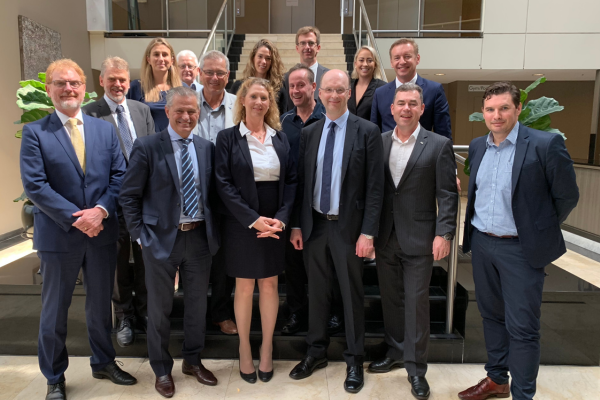 (L-R) The original SmartSat CRC bid team (back) Nick Stacy, Flavia Tata Nardini, Roger Frazen AO, Tony Wheeler, Eva Rodriguez Rodriguez, Gottfried Lechner, Emily White, Thomas Pfister, (front) Peter Kerr, Professor Andy Koronios, Professor Anna Moore, Peter Nikoloff, Dr Peter Woodgate, Shaun Wilson and Andrew Beveridge preparing for the final round interview in 2018
Through this collaborative model, SmartSat leveraged more than $270 million in combined investment and delivered over 200 research and development projects across satellite communications, artificial intelligence, autonomous systems, Earth observation, space situational awareness, and positioning, navigation and timing technologies.
One of SmartSat’s defining achievements was bringing together Australia’s diverse space community into a connected national innovation ecosystem. Over its lifetime, the CRC engaged more than 175 Australian and international partners and more than 400 researchers, creating one of the largest concentrations of space research capability ever assembled in Australia. By reducing fragmentation across the sector, SmartSat fostered knowledge sharing, accelerated research translation, and created new opportunities for technology development and commercialisation.
This national approach was strengthened through the establishment of a distributed network of SmartSat Nodes. Developed in partnership with State and Territory Governments and leading universities, the Nodes created regional centres of innovation that connected local businesses and researchers with national programs, specialist expertise, investment opportunities and collaborative networks, strengthening regional capability while contributing to a coordinated national innovation system.
Developing Australia’s future space workforce remained a central priority throughout the CRC. SmartSat supported 72 PhD candidates and created opportunities for researchers and students to work alongside industry, helping develop a new generation of highly skilled scientists, engineers and innovators. The CRC also facilitated international placements and internships with globally recognised organisations including NASA’s Jet Propulsion Laboratory (JPL) and the European Space Agency (ESA), providing Australian researchers with access to world-leading facilities, expertise and international networks.
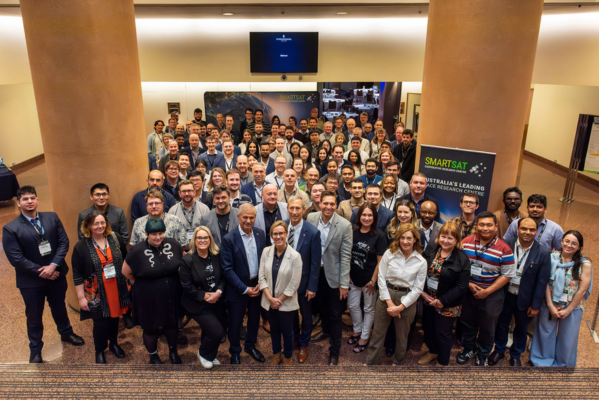 The SmartSat community in Adelaide, South Australia for the Annual SmartSat CRC Conference in 2024
SmartSat also strengthened Australia’s international engagement by positioning Australian organisations as trusted partners in global space collaboration. Through initiatives such as the UK Space Bridge and the Australia-New Zealand Collaborative Space Program, participants established relationships with leading international space agencies, research institutions and commercial organisations. These partnerships supported collaborative research, technology exchange, project development and access to international markets.
The CRC also helped nurture Australia’s commercial space sector by supporting more than 60 space start-ups and emerging companies. Through access to funding, expertise, infrastructure and collaborative networks, these organisations were able to progress technologies from concept through demonstration to commercial application, with many now making significant contributions to Australia’s growing space industry.
Collectively, these achievements have created a lasting legacy. Independent analysis estimates that SmartSat-supported research, innovation and industry development activities will generate more than $1.2 billion in economic impact, delivering substantial returns on the Commonwealth’s investment while strengthening Australia’s sovereign capability in strategically important technologies.
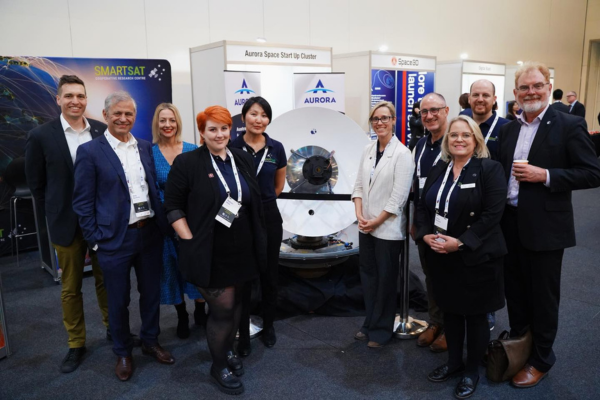 SmartSat team (L-R) Dr Carl Seubert, Professor Andy Koronios, Elizabeth Weeks, Madison White, Tuul Machlay, Dr Sarah Cannard, Jeff Kasparian, Alison Bowman, Dr Andrew Barton and Peter Kerr with the CHORUS Terminal on display at the 15th Australian Space Forum in 2023
Delivering on the CRC Commitment to the Commonwealth and our Partners
SmartSat CRC has successfully delivered the vast majority of its commitments under the Cooperative Research Centres Program, completing 90 Commonwealth milestones in full. This achievement reflects the commitment of the CRC’s partners, researchers, staff and stakeholders, and demonstrates the effectiveness of the CRC model in translating research excellence into industry outcomes and national capability.
The remaining 16 milestones will continue through planned project novations to the Australasian Space Innovation Institute (ASII), ensuring continuity of funding, personnel, partnerships and delivery capability beyond the CRC term. This transition enables projects to mature and achieve their intended outcomes without disruption, preserving the value of Commonwealth and partner investment while maintaining momentum in strategically important areas of research and innovation. The sole remaining milestone requiring future completion is dependent on securing an appropriate spaceflight opportunity to undertake final on-orbit software testing and validation.
While SmartSat CRC formally concludes on 30 June 2026, its impact will continue through ASII. The relationships established between industry, government, academia and research organisations, together with the knowledge, intellectual property, workforce capability and collaborative culture developed through SmartSat, provide a strong foundation for continued innovation. As these projects, partnerships and capabilities transition into ASII, the investment made through SmartSat CRC will continue to strengthen Australia’s space sector and shape the nation’s future space capability for many years to come.