SmartSat’s SCARLET-β project is improving the performance of small satellites and their payloads by increasing their autonomy and reducing the need for constant human oversight.
The specific problem driving this project was the need for enhanced autonomous capabilities in satellite self-inspection and Earth observation operations, which are critical for the Defence Science & Technology Group (DSTG)’s Buccaneer Main Mission (BMM). End-users faced limitations due to the reliance on human interaction for these operations, which hindered efficiency and optimal use of small spacecraft and their payloads.
The SCARLET-β project is developing intelligent algorithms, progressing the advancement of spacecraft autonomy and enabling more capability and optimality from small spacecraft and their payloads with less reliance on constant human interaction.
BMM features the MANTIS (Manoeuvrable Antenna and Terrestrial Imaging System) payload with a controllable, deployable arm for satellite self-inspection imaging. The algorithm developed by the University of Sydney permits the payload to take an optimal image of itself against a backdrop of Australia from orbit in near-real time. The algorithm also permits the acquisition of optimal images of the Earth’s surface for Earth observation.
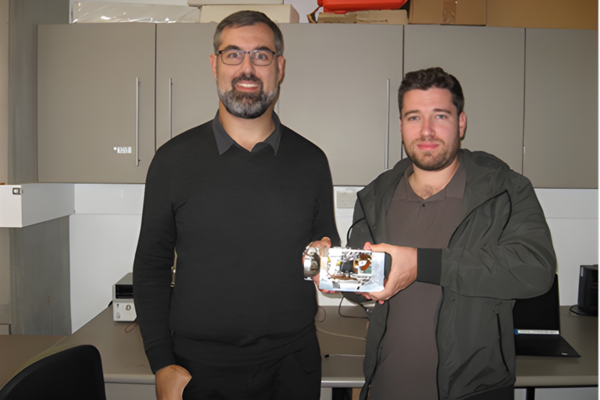 Dr Nathan Wallace (left) and Thomas Ingram from the Australian Centre for Field Robotics at the University of Sydney receiving the MANTIS Engineering Model ready for HWIL testing at DSTG Eveleigh, NSW in July 2025.
This project enables a greater opportunity for researchers to study the relationship between on-board and off-board autonomy. Additionally, the work allows for the integrated scheduling of data acquisition and downlink, combined with energy aware planning.
The testing and development of these groundbreaking algorithms by the University of Sydney team were first undertaken using a simulation. Following that, the MANTIS Engineering Model was prepared at DSTG’s Fisherman’s Bend facility in Victoria before being relocated to DSTG’s Eveleigh offices in New South Wales. This enabled the development of a standalone hardware-in-the-loop (HWIL) testbed, allowing the next phase of testing of the autonomous mission planning system.
The following phase of testing involved integrating the MANTIS Engineering Model inside the ground-based BMM Engineering Model Spacecraft. This was done at DSTG’s Edinburgh Base in South Australia, where further HWIL testing was conducted within the facility’s Ground Segment, utilising existing radio frequency communications infrastructure. This was to confirm the autonomous sequence of operations was qualified before execution on the BMM Flight Model in low Earth orbit.
SmartSat’s Chief Research Officer, Carl Seubuert said of the project, “SCARLET-β exemplifies how Australian autonomy researchers can partner with Defence to make a high-impact demonstration in space.”
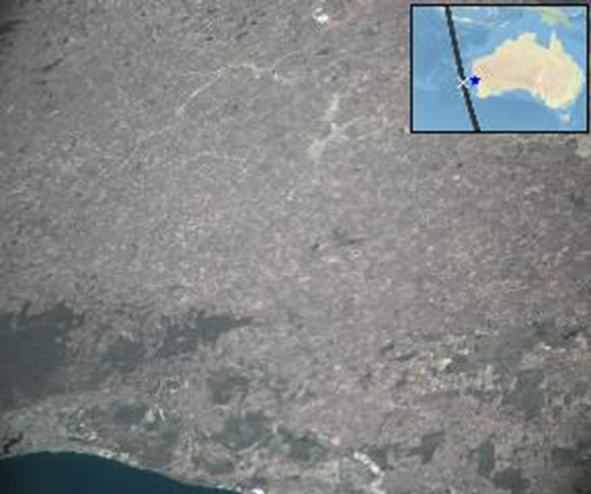 Earth image captured by the Buccaneer Main Mission (BMM) satellite during a recent person-in-the-loop BMM Flight Model test of the developed autonomy pipeline, showing a picture of Perth (lower left) and surrounding countryside.
[Inset: Imaged location (in blue) and satellite position at time of capture (in white) (Wallace et. al., 2025)]
Australia is building space skills, hardware, and capabilities, and this must include autonomous algorithms to remain innovative in space system development and implementation. This project is a flagship of the SmartSat initiative SCARLET (Spacecraft Autonomy Research Laboratory) to bring together researchers and industry to focus and coalesce efforts to advance spacecraft autonomy for tangible outcomes.
This autonomy project is experimenting with advancing the use of autonomy in space and is a precursor to future autonomy needs of the space hybrid architecture using smaller, smarter constellations of spacecraft.
The primary near-term impact is to practically demonstrate to Defence the use of goal-oriented distributed autonomy on a multi-functional platform, and to provide a pathway to integrate distributed autonomy on future Defence platforms. The longer-term impact of this work is that system-level and goal-oriented autonomy becomes the foundation for future smarter spacecraft that rely less on human interaction in their operations.
In early December 2025 the project team conducted their first end-to-end on-orbit demonstration of mission-level autonomy. In the remaining six months of the project, the team will build upon that demonstration and improve the BMM’s ability to tackle increasingly complex autonomous planning tasks.
This project is part of a broader plan under the SmartSat initiative to continuously advance spacecraft autonomy. Future plans include exploring additional commercial applications of these autonomy technologies.