During natural disasters in remote regions, communication systems often fail when they are needed most.
When it comes to communications, emergency services teams often face unreliable networks, limited bandwidth, and fragmented infrastructure, making coordination difficult and delaying response efforts in situations when time is often of the difference between life and death.
Traditional solutions to these issues rely on stable connectivity and high data rates, which are rarely available in extreme conditions, such as during bushfires or extreme flood events. This creates a gap between what emergency responders need and what existing communication systems can deliver in real-world scenarios.
This is the problem Francis Kagai from Swinburne University of Technology has set out to address throughout his SmartSat sponsored PhD. His project works with the enhanced system requirements and resilient architectural designs, waveforms and protocols developed through SmartSat Project P1.70 Resilient Emergency Search and Rescue Communications Phase 1 and 2. These findings are integrated into a user terminal, or ‘beacon’, that can help those in at-risk areas access emergency services during natural disasters.
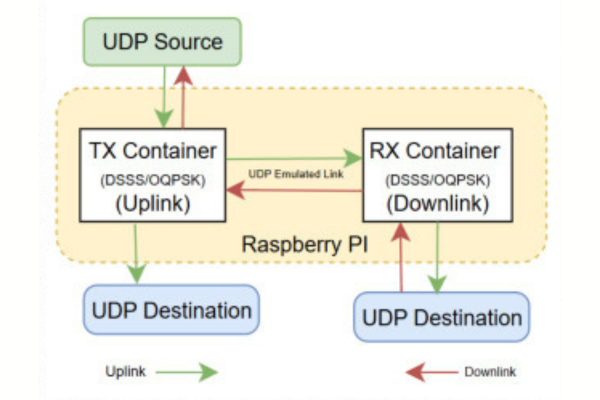 Figure shows a containerized software-defined radio pipeline running on a Raspberry Pi. The TX container (uplink) takes application data from a UDP source and modulates it using DSSS or OQPSK before transmission. The RX container (downlink) performs the inverse, demodulating incoming signals and forwarding them to a UDP destination. Between them is a UDP-emulated link, used for testing or hybrid backhaul without requiring a physical RF channel.
Beacon devices must be reliable while remaining low-cost and low-power, suitable for long life operation on a battery pack. The device is exclusively designed for use during communications blackouts or other emergencies such as bushfire. It will support an emergency beacon function and allow a user to send pre-canned messages and, where enabled, text messages, using a mobile phone app tethered to the beacon device.
The result is a resilient communication approach that works under the extreme constraints that come with instances of natural disaster. It combines satellite links, low-bitrate voice communication, and lightweight wireless technologies such as LoRa (Long Range) to maintain connectivity even when networks are degraded. Instead of focusing on high performance, the system prioritises reliability and usability.
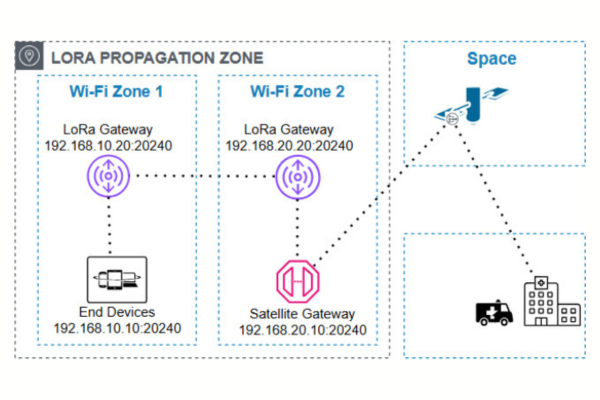 Figure illustrates a multi-layer communication architecture for constrained environments. At the edge, LoRa end devices operate within local propagation zones. These connect to LoRa gateways deployed across WiFi zones. The gateways forward traffic via IP networks to a satellite gateway, which provides long-range backhaul.
Francis said of the project, “reliable communication in constrained environments is not about speed or capacity; it is about ensuring that critical information gets through when everything else fails.”
Voice communication was optimised to remain intelligible even at very low data rates, enabling communication where conventional systems would fail. The design also integrates security considerations to ensure that sensitive information remains protected over time. Through testing and field-based evaluation, this approach demonstrated that meaningful communication can be sustained even in highly constrained environments.
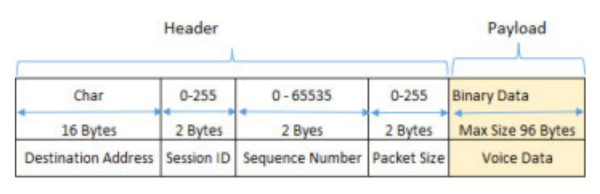 Figure defines a compact packet format optimized for constrained links.
“Resilience comes from simple, coordinated design choices across the system, rather than reliance on a single technology,” said Francis.
This work contributes to improving the reliability of communication in emergencies and remote operations, directly supporting faster coordination and decision-making. By enabling communication at low data rates, the solution reduces dependence on expensive or high-capacity infrastructure.
The project aligns with Australia’s focus on sovereign capability in space and resilient communications. Through collaboration with the SmartSat CRC, this work supports the development of satellite-enabled systems that can operate in challenging environments, including disaster zones and regional areas. The outcome of this work also provides a foundation for future communication systems that integrate satellite and terrestrial networks, improving national resilience and preparedness.
The future of this work will focus on scaling the system and integrating adaptive capabilities that allow networks to adjust automatically to changing conditions. There is also potential to extend the approach to other sectors, including environmental monitoring, remote industry operations, and critical infrastructure.
Ongoing research is exploring how autonomous system control and tighter satellite integration can further improve reliability and performance.
Francis Kagai is a versatile professional with extensive experience in ICT and project management. He holds a Master of Science in Computer Science from Staffordshire University, as well as an MBA from the University of Sunderland, both in the UK. You can find out more on his profile here.