The Adelaide University Space Society (AUSS) recently hosted a panel discussion on the topic of Sustainability in Space, where SmartSat CRC’s Research Program Manager, Dr Andrew Barton, joined as one of the panellists.
The event took place at the Australian Space Discovery Centre at Lot Fourteen, Adelaide and was attended by students from across the university, as well as members of the general public. Reflecting the highly interdisciplinary nature of the sustainability field, the attendees were from diverse disciplines including engineering, astronomy, occupational therapy and genetics.
Alongside Andrew, the other panellists were Charlotte Brampton from Plants for Space and Tom Wolinski from Paladin Space. The panel discussion was moderated by Grant Mildwaters, secretary of the AUSS.
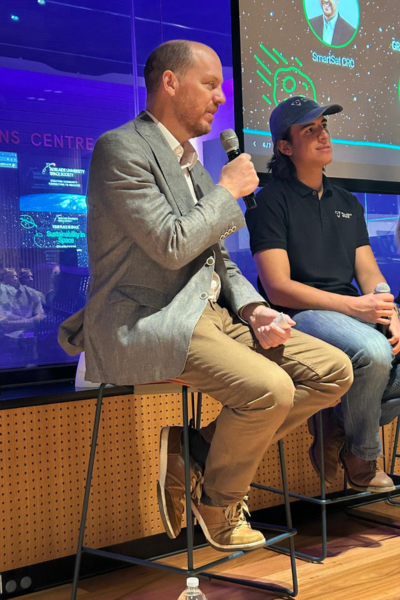 SmartSat CRC Research Program Manager, Dr Andrew Barton, speaking on SmartSat’s contribution to supporting sustainable space technologies. (Image courtesy of AUSS)
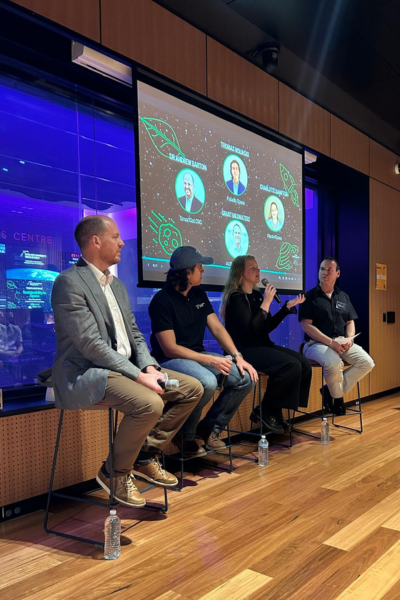 (L-R) Dr Andrew Barton from SmartSat CRC, Tom Wolinski from Paladin Space, and Charlotte Brampton from Plants for Space on the panel moderated by Secretary of the AUSS, Grant Mildwaters. (Image courtesy of AUSS)
Andrew summarised sustainable space technologies that have been supported through SmartSat’s research program. Those fall into two main categories; mitigation of space debris and radio spectrum management. Notable projects in those areas include Trusted AI Frameworks for Change Detection, S-JAR, ISAM, E-SPARC and CogSat. Debris mitigation starts with responsible behaviour by spacecraft operators who should take care to avoid collisions, catastrophic onboard failures that generate fragments and leaving dead satellites in orbit. However, the broader problem of space debris is also addressed by having the ability to service and repair existing satellites, that extending their lifetime. Andrew also talked to his encounters with sustainability issues earlier in his career when he was involved in the procurement of satellites and launch services.
Charlotte Brampton addressed space biology, the role of plants in long-term settlements, and closed-loop life support systems. One of the key pillar of sustainability is social aspects, and Charlotte explained how plants are more than just a source of nutrition for astronauts, but they also contribute significantly to emotional wellbeing which will be crucial for sustaining effective teamwork in long duration space missions.
Tom Wolinski tackled commercial incentives, space debris removal, ownership jurisdiction, and international orbital frameworks. Tom’s employer, Paladin Space, is pioneering the collection of small pieces of space debris. Their debris collection spacecraft currently under development will be able to efficiently maneuverer around orbit to gather up many small fragments. Each fragment they collect will be one less object that satellite operators need to avoid. This has an increasing economic impact as we move into the era of “mega constellations” with tens of thousands of spacecraft that are sharing an increasingly congested Low Earth Orbit.
The panel also responded to questions from the audience, some of which related to longer-term trends. Of particular note was the overarching question of who is responsible for ensuring that space is managed in a sustainable way. The consensus among the panel members was that ultimately it will be up to governments to put in place (and enforce) the necessary regulations. However, given that space is inherently an international endeavour, international bodies like the UN will certainly be needed as part of any global solutions. Due to the complexities of international consensus-building that can take an excessively long time, there is a strong need for national governments, private companies and even individual employees in the space sector to take responsibility for their own actions in the interim and take steps that are within their control to maximise the sustainability outcomes. That could include things like carefully choosing the materials of spacecraft hardware to minimise environmental harm, designing space systems to be modular and repairable, and taking extra precautions in spacecraft operations.
There was also recognition among the audience of the impact that an ever-increasing cadence of rocket launches will have on the Earth’s atmosphere. The panel members discussed some trends in rocket propellants that are leading to reduced environmental harm but acknowledged that fully ‘green’ solutions may not be possible. Thus, despite the benefits that satellites bring to helping manage Earth’s environment, there might always be a compromise in having to launch those satellites through Earth’s atmosphere in the first place. In the longer term the ideal scenario might be to source the materials and fuels needed for space activities from asteroids and the Moon, but that would be a topic for another panel.
Dr Andrew Barton
Research Program Manager