SmartSat’s Scarlet- γ (Gamma) project is advancing autonomy for future multi-satellite missions that require greater precision, flexibility, and efficiency. The research is aligned to the Takahē mission concept, as an exemplar application, and aims for the mature technology to be an enabler for Australia’s sovereign capability in spacecraft autonomy and formation flight.
Scarlet Gamma is making substantial technical progress, with the project now moving closer to mission application. The team recently held a technical review in Melbourne and further aligned the technology to real-world implementation and more closely to the Takahē mission concept of operations. The project was conceived by SmartSat’s Chief Research Officer, Dr Carl Seubert, and is led by Professor Shannon Ryan at Deakin University‘s Applied Artificial Intelligence Institute (A2I2).
This mission focus reflects the original purpose of Scarlet Gamma, to develop a new framework for autonomous multi-spacecraft control. It is designed for missions that are becoming more complex and demanding, specifically multi-spacecraft formation flying to enable mission concepts achieving innovative remote sensing geometries or controlling in highly dynamic orbits, such as very low Earth orbit (VLEO).
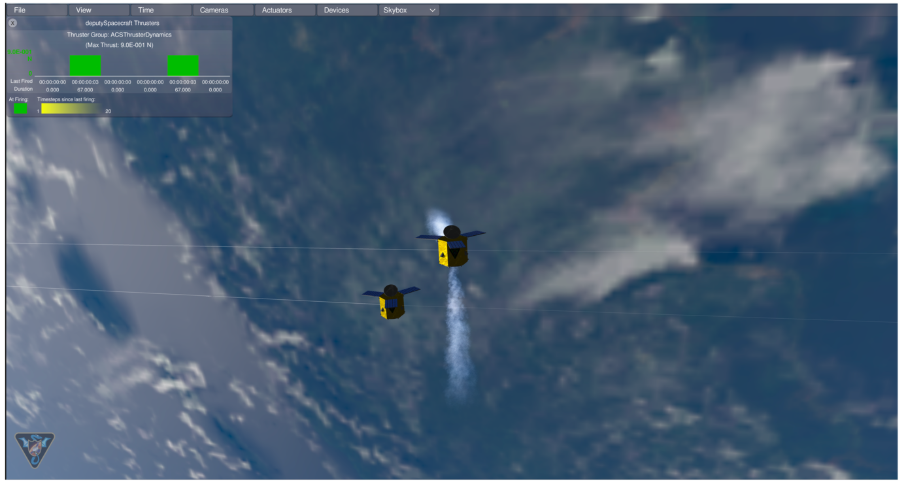 A graphical visualisation of the close and precise formation flight using Scarlet Gamet control algorithms, being tested in the Basilisk high-fidelity modelling simulation.
Mission scenarios such as these places further demands on spacecraft, and consequently it’s why there are so few precise formations flying in orbit. These systems need real-time decision making under varying conditions and sensing limitations, while being ultra efficient with propellant to enable longevity and mission success. Traditional multi-spacecraft control systems rely on simplified models and robust algorithms. Scarlet Gamma is exploring novel Guidance and Control (G&C) approaches that leverage relative dynamic motions and utilise high-fidelity models that can be run onboard in real-time.
To build this capability, the research team of two postdoctoral researchers are advancing the underlying algorithms and performing complex simulations to stress and validate the solutions. These simulations are leveraging Basilisk, an open-source astrodynamics and flight software simulation environment developed by Professor Hanspeter Schaub and researchers at the University of Colorado Boulder.
The team is comparing performance and propellant savings against more classic Linear Quadratic Regulator and Model Predictive Control baselines. The simulations are for modelling spacecraft behaviour and evaluate mission concepts with the intent to take the mature algorithms through real-time testing on flight-like processors – a must for precise formation control implementation.
Scarlet Gamma forms part of SmartSat CRC’s wider Scarlet Lab program, which is dedicated to developing and advancing Australia’s technologies in spacecraft autonomy and onboard AI. Scarlet Gamma is directly tied to the emerging activities of the Australasian Space Innovation Institute (ASII) and will transfer to the institute for further development. ASII continues to work on the Takahē mission concept, which is a dual-spacecraft SAR formation flying mission for maritime domain awareness. It is being developed by ASII and New Zealand’s Restore Lab, with approximately $2.4 million in Ministry of Business, Innovation and Employment backing.
This connection is also helping the project attract wider interest. International satellite operators are already engaging with the work because they see the value of autonomous formation flying for next-generation remote sensing from space.
Elizabeth Weeks
Research Portfolio Manager