SmartSat’s flagship project for space mission autonomy, Scarlet-α (Alpha), has demonstrated its latest AI-based algorithms for distributed space systems autonomy with selected use case scenarios for resilient multi-spacecraft Earth Observation and Intelligence, Surveillance, and Reconnaissance (ISR) in maritime and bushfire domains at the mid-third year project workshop with industry and defence partners.
The objective of the Scarlet Alpha project is to develop new capabilities for spacecraft autonomy and onboard AI for next generation space systems, such as dynamically networked formations of heterogeneous satellites. Spacecraft autonomy has been recognised as a key enabler of the next-generation space systems that aim at increasing responsiveness and continuity of space-based observations, covering large areas with higher resolutions, minimising communication and data access latencies, and reducing costs of both the space and ground segments.
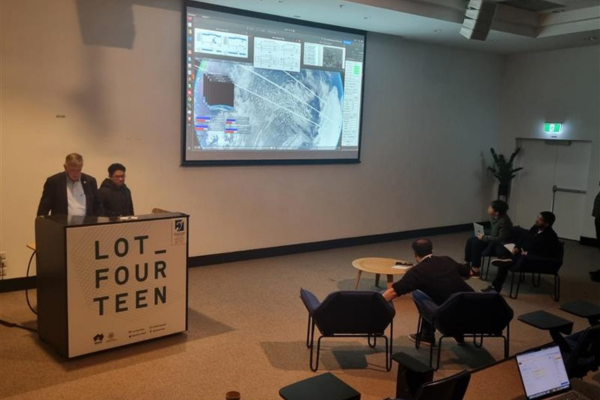 The Scarlet Alpha mid-year review, hosted at Lot Fourteen in Adelaide, South Australia
The Scarlet Alpha project is developing novel concepts, methods and technologies for goal-oriented AI-based autonomy onboard to enable distributed space systems achieve mission goals through autonomous onboard perceiving, decision-making and acting.
The project is being carried out in four work packages, with various academic and industry partners:
The project has developed and demonstrated autonomous AI algorithms with initial proof-of-concept (PoC) implementations through software and Hardware-in-the-Loop (HIL) simulations with the use cases consulted with the industry and defence partners. In addition to the specific AI-based autonomy capabilities developed by individual WPs, the first end-to-end demonstration has also been developed and showcased with new consolidated autonomy capabilities enabled by several WPs.
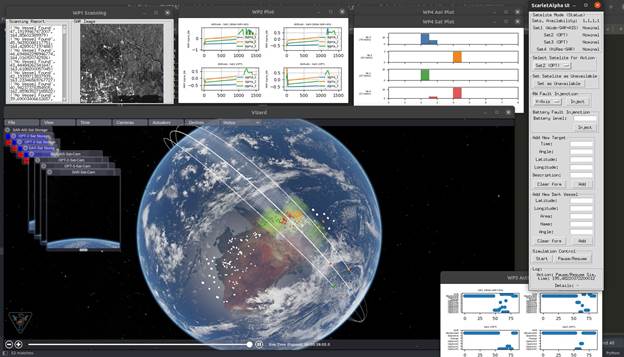 Simulated demonstration of end-to-end autonomy capabilities provided by integrated work packages
The current use case scenarios involve autonomous responses to dynamic events in multi-operator satellite constellations and heterogenous satellite clusters to ensure mission goals are achieved without human intervention. To enable demonstration of autonomous tip-and-cue capabilities, the current test-bed simulated satellite cluster is composed of a front satellite with a broad area scan Synthetic Aperture Radar (SAR) and Automatic Identification System (AIS) sensors for dark vessel detection, and a cloud mapper for real-time cloud detection, two side trailing high resolution optical satellites, and a rear trailing high-resolution SAR for maritime surveillance and bushfire monitoring. The current consolidated demonstration of AI-based autonomy capabilities includes:
- Autonomous replanning of virtual constellation tasking when a satellite in a constellation becomes unavailable
- Dynamic rescheduling of cluster-based observation and onboard SAR analysis of target area when a new maritime area of interest is requested by a customer
- Dynamic re-optimisation of cluster actions to capture a new high-priority target using trailing satellites, incl. high resolution SAR, when a dark ship is detected by a front satellite in the cluster
- Autonomous detection and isolation of a cluster fault occurring onboard a satellite in the cluster (e.g. radiation upset on selected component), and then adjusting cluster actions to quasi-optimally reallocate targeting with reduced system resources
In its third year, the Scarlet Alpha project will continue developing new AI-based algorithms and integrated PoCs demonstrating advanced spacecraft autonomy capabilities, enabling new types of space-based services, that are available for uptake, translation and commercialisation by industry & defence partners.