Modern satellite, defence, and high-altitude communication systems are rapidly moving toward the millimetre-wave and terahertz (THz) spectrum to enable faster, more secure data transmission. However, manufacturing devices that operate at these frequencies (sizes 10 µm to 1 mm) remains a major challenge.
Existing techniques struggle to produce the complex, high-precision 3D structures, especially when combining advanced materials such as ceramics, carbon, and metals. This limitation is slowing innovation across Australia’s space, defence, and advanced materials sectors, where compact, lightweight, and high-performance components are critical.
To address this challenge, this SmartSat-supported PhD project from Dr Vibhor Thapliyal at La Trobe University has developed a new manufacturing process that uses laser energy to grow materials directly from gas, enabling true 3D fabrication at the microscale.
“This research pushes the boundaries of advanced manufacturing in Australia,” said Vibhor. “It shows how we can build complex 3D structures at the microscale to control signals in ways that were not previously possible, unlocking new opportunities for space and defence technologies.”
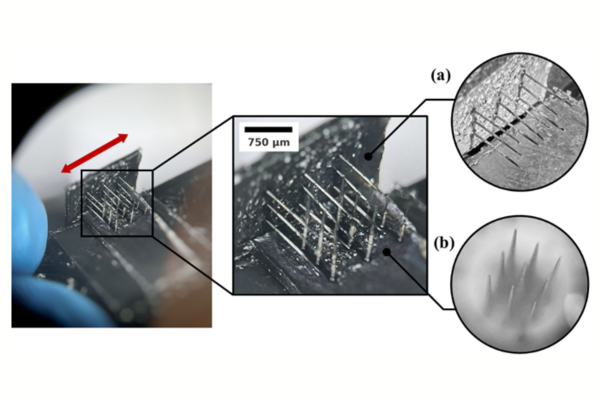 A small 3D lattice made of stacked fibres arranged in a precise grid, designed to control electromagnetic signals.
Over the course of the research, more than 600 fibres were successfully grown using carbon and titanium-based precursors. These were assembled into a 3D photonic crystal, capable of controlling and filtering THz signals. Unlike traditional methods, this approach not only builds structures directly in 3D without moulds or supports, but it enables multi-material integration within a single structure, achieving high precision and repeatability.
The project delivered the successful demonstration of a 3D photonic crystal using this laser-based process, with simulations confirming operation in the 0.12–0.14 THz range. Simulations confirmed operation in the 0.12–0.14 THz range, demonstrating the feasibility of this approach for real-world photonic and metamaterial devices.
This technology establishes a new capability for advanced manufacturing in Australia, directly supporting the nation’s space and defence priorities. It enables the manufacture of smaller, lighter, and more efficient communication hardware and high-performance frequency filters for secure data transmission. It also unlocks new possibilities for manufacturing using complex metamaterials.
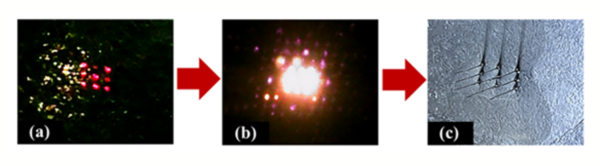 A sequence showing fibres growing vertically from a surface under laser heating inside a high-pressure environment, directly from the gas phase.
For defence manufacturing, this opens pathways for frequency-selective filters and signal control devices, the development of compact sensing and surveillance technologies, as well as advanced materials for next-generation communication systems. Most importantly, the process is scalable and adaptable, supporting future industrial deployment.
The next phase of this work will focus on experimental validation of THz performance in real systems. Future development will explore the potential for actively tunable photonic devices, integration with micro-scale actuators (MEMS), expansion to new materials and hybrid systems, and further defence applications, including sensing and frequency-selective filtering.
This project demonstrates how SmartSat is translating advanced research into technologies aligned with Australia’s space and defence priorities, accelerating the pathway toward commercial deployment. The advancements made through this research will accelerate the path toward commercial deployment in satellite, sensing, and defence platforms.
Dr Vibhor Thapliyal has recently completed his PhD in Advanced Manufacturing from LaTrobe University, supported by SmartSat, and is seeking work in either a R&D or Postdoctoral Researcher roles. His expertise spans laser-based processing, additive manufacturing, and experimental R&D for space and defence applications. See Vibhor’s profile here.